

2027: NDC Raises Alarm Over Alleged Plot To Silence Peter Obi
- Accuses Fed Govt Of Enabling Opposition Crackdown
The National Democratic Congress (NDC) has accused the Federal Government of allowing an increasingly hostile political environment in which opposition candidates, supporters and campaign structures are allegedly being subjected to systematic intimidation, violent attacks and administrative obstruction ahead of the 2027 general elections.
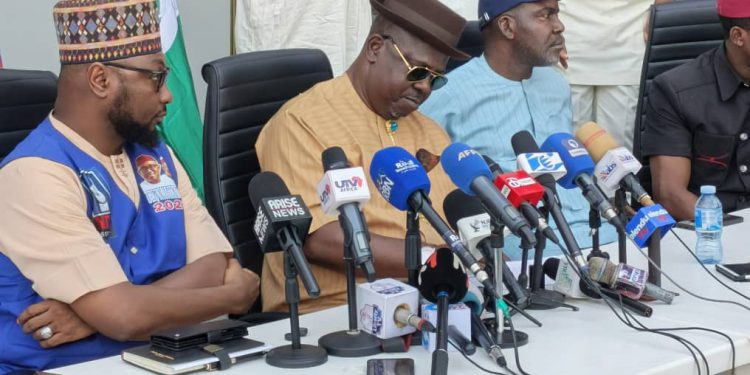
In an explosive political intervention, the party’s National Chairman, Senator Moses Cleopas, on Tuesday challenged the authorities to explain why the NDC, its presidential candidate, Mr Peter Gregory Obi, and other prominent party figures had allegedly become recurring targets of violence across different parts of the country.
Addressing a world press conference in Abuja, Sen Cleopas presented a catalogue of alleged attacks spanning Enugu, Delta, Lagos, Kano, Cross River, Anambra and Imo states, accusing those behind the incidents of attempting to undermine the party’s political mobilisation and weaken its capacity to challenge for power in 2027.
The NDC National Chairman argued that the geographical spread, recurrence and apparent targeting of NDC activities raised questions beyond ordinary political disagreements, describing the situation as a potential threat to opposition participation and Nigeria’s multi-party democratic system.
His most consequential allegation was that the ruling establishment was uncomfortable with the NDC’s growing political presence and had allegedly resorted to intimidation to frustrate its candidates.
“Our candidates are not the only candidates vying for elective positions in this country. Specifically, Mr Peter Gregory Obi is not the only presidential candidate in the forthcoming general elections. So the question is, why is NDC and its candidate being the one that is always attacked and assaulted?” he asked.
He added that the party believed the alleged pattern reflected political fear of the opposition.
“There can be only one assumed answer, that the government in power is afraid of the NDC. The government in power is afraid of our presidential candidate, Mr Peter Obi, and all the candidates of the NDC, and they have resorted to intimidation to frustrate our campaigns,” Cleopas declared.
The Federal Government’s alleged involvement was not independently established in the chairman’s presentation.
Nevertheless, the accusations raise serious questions about the responsibility of government authorities to guarantee equal political rights, protect opposition activities and prevent violence from determining the boundaries of electoral competition.
For the NDC, the issue is no longer merely about attacks on individual supporters. It is about whether an opposition party can freely organise, mobilise, campaign and present its candidates to Nigerians without fear.
In presenting his allegations, Sen Cleopas identified incidents across seven states, arguing that the frequency of reported attacks had created an atmosphere of insecurity around the party’s political activities.
In Enugu State, he recalled an incident on September 12, 2026, when armed men allegedly disrupted a grassroots ward meeting at Ogofia, Akunana, in Nkana West Local Government Area, leaving eight members with gunshot wounds.
He also alleged that on October 10, armed attackers invaded a gathering at the campaign office of the party’s governorship candidate, Christian Chinyata Oha, in Enugu GRA, killing a party member identified as Kunwarie Christopher.
The NDC National Chairman questioned why ordinary political consultations were attracting violent responses in a democratic society.
“We have not gone into election. This is not full-blown campaign in a stadium, just town hall meeting. Party members come, let’s talk together, is a problem,” he lamented.
In Delta State, Sen Cleopas described what he called a sustained pattern of attacks against the party’s governorship candidate, supporters and campaign activities.
He alleged that the candidate was attacked in Agolokwe on July 29, alongside an assault on party supporters at the Petroleum Training Institute (PTI), Effurun.
On August 13, he said armed men attacked the convoy of Senator Ovie Omo-Agege in Kuse, Ughelli South Local Government Area, leaving six members injured.
He further alleged that more than 50 armed men invaded and destroyed a venue prepared for an NDC campaign meeting in Ughelli on August 21.
The NDC National Chairman also cited the disruption of a mobilisation march along Airport and Refinery Road in Effurun on September 18, during which at least one person was reportedly shot, followed by another alleged attack on the party’s mobilisation procession in Warri the next day.
He said the party’s One Million Man March in Asaba was also attacked on November 7.
But the most disturbing allegation concerned a campaign gathering organised for Omo-Agege in Udu, Ughelli North Local Government Area, where Cleopas said four NDC members were killed.
He noted that the Police reportedly gave a preliminary death toll of six, while several other participants sustained critical injuries.
The NDC National Chairman’s account raises questions about the circumstances surrounding the reported fatalities, the identity of the attackers and the progress of investigations.
The NDC Chairman’s allegations took a more serious dimension when he identified incidents involving the party’s presidential candidate, Peter Obi, and vice-presidential candidate, Rabiu Musa Kwankwaso.
In Lagos, Sen Cleopas alleged that armed men disrupted a party town hall meeting in Oregun, Ikeja, on November 12, assaulted a journalist and seized his equipment.
He described the incident as evidence of the growing vulnerability of media professionals covering political activities.
In Kano, he alleged that suspected political thugs attacked the convoy of Kwankwaso and the party’s governorship candidate, Aminu Abdulsalam Waziri, near the Bichi Local Government Secretariat on November 15.
According to him, the attackers blocked the road, smashed vehicle windshields and injured several supporters.
The NDC National Chairman also alleged that Obi and Kwankwaso narrowly escaped an attack in Calabar, Cross River State, when armed men carrying sticks and machetes descended on their convoy along Watt Road.
He said the incident occurred as the politicians were travelling from the palace of the Obong of Calabar to a scheduled town hall meeting.
Although the two politicians reportedly escaped unhurt, several campaign vehicles were damaged and their windows smashed.
The allegations raise a significant national security question: if prominent political figures and their supporters cannot undertake legitimate political engagements without fear of attack, what guarantees exist for ordinary Nigerians participating in grassroots electoral activities?
Sen Cleopas also accused authorities in Anambra and Imo states of using administrative measures to frustrate the party’s political activities.
In Anambra, he alleged that government agents removed a campaign billboard belonging to Senator Victor Umeh, representing Anambra Central, despite payment of the required fees.
He claimed the billboard was pulled down because it displayed photographs of Umeh alongside Peter Obi.
“What is his offence? His offence was putting an image of Peter Obi alongside his own on the billboard,” he said.
In Imo State, the NDC National Chairman alleged that party meetings had been disrupted, campaign banners and billboards destroyed, while an event centre owner who leased his facility to the NDC for a political programme was threatened with demolition.
These allegations introduce another important dimension to the political controversy: whether administrative powers are being exercised consistently or selectively against opposition parties.
The NDC maintains that it is entitled to the same political and commercial freedoms enjoyed by other parties, including access to venues, lawful outdoor advertising and the ability to organise meetings.
Beyond the political accusations, Cleopas devoted considerable attention to the human consequences of the alleged violence, describing the loss of lives as an irreversible tragedy that should never be associated with electoral competition.
He condemned attacks on unarmed supporters, insisting that political disagreements should not become a justification for killing citizens.
“There is no soul that is lost that can be recovered, and so when it gets to that level, it becomes irredeemable,” he said.
Despite the reported deaths, injuries and destruction, the chairman declared that the NDC would not abandon its ambition to contest the 2027 elections.
He insisted that intimidation would not force the party out of the political process or discourage its supporters from exercising their constitutional rights.
“Hear me, Nigerians and the entire globe, the NDC will not allow itself to be intimidated out of 2027 elections,” he declared.
He maintained that the party would mobilise voters and defend its votes through lawful democratic processes.
“Our supporters will vote, our votes shall be counted, our votes shall be defended, protected, announced, and we believe that we shall be declared winners of the 2027 general election,” he said.
In one of the strongest political declarations of the briefing, Cleopas warned against any attempt to reduce Nigeria’s political space to a one-party arrangement.
“They cannot kill all. Nigeria must not be intimidated or boxed into a one-party state,” he declared.
He urged Nigerians to resist fear and continue supporting multi-party democracy, insisting that political participation must remain a constitutional right rather than a privilege granted by those in power.
The NDC also called on the international community, democratic institutions and development partners to closely monitor the political environment ahead of the 2027 elections.
Sen Cleopas argued that Nigeria’s strategic importance to Africa and the international community made the protection of its democratic institutions a matter of wider regional and global interest.
He urged international observers to examine the allegations presented by the party and encourage measures that would protect political freedoms, opposition participation and the safety of electoral stakeholders.
He placed particular responsibility on the Federal Government, arguing that protecting citizens should not depend on their political affiliations.
“But when a government that you are entrusted to take care of its citizens and its nation is failing or failed, as you have seen, then you also don’t expect people to close their mouth,” he said.
The NDC National Chairman was accompanied by the Director-General of the party’s campaign organisation, an allegedly attacked governorship candidate and other party officials, whom he presented as participants with direct knowledge of some of the reported incidents.
He insisted that the allegations deserved serious attention rather than political dismissal.
The NDC’s allegations have placed three critical issues at the centre of the emerging 2027 political conversation: the security of opposition politicians, the impartiality of government institutions and the capacity of security agencies to protect political activities across party lines.
The Federal Government’s responsibility is particularly significant because the state has an obligation to protect all citizens, regardless of their political affiliations.
Equally, state governments and security agencies must ensure that lawful political activities are not subjected to selective restrictions or intimidation.
The allegations against the authorities and unidentified attackers require independent investigation.
The NDC’s account alone does not establish who sponsored or carried out the reported attacks, nor does it establish that the Federal Government directed them.
However, the reported deaths, injuries and destruction of campaign properties demand credible answers, transparent investigations and accountability.
The Police and other relevant security institutions face an important test: establishing the facts, identifying perpetrators, prosecuting offenders and demonstrating that political violence will not enjoy protection or impunity.
For INEC, the wider concern is that electoral credibility begins long before ballot papers are distributed.
It requires an environment in which political parties can campaign freely, candidates can reach voters, journalists can report without intimidation and citizens can make political choices without fear.
Sen Cleopas concluded with a warning that the NDC would not surrender its political ambition, regardless of the threats it alleges to be facing.
“If you can kill all, that is when you will have your way. But if you cannot kill all, and there is only one that is even left, you shall be defeated by the power of the people,” he declared.
The unfolding controversy now presents Nigeria with a fundamental democratic question: Can the country guarantee a genuinely competitive 2027 election if opposition parties cannot demonstrate that their members, candidates and supporters are safe to participate in the political process?